By Niall Hassard
As a licensing solicitor not a week passes without a client contacting the firm for advice on pricing.
The industry has never been under so much pressure to attract and retain customers. Customers that are, by and large, balancing socialising with the cost-of-living crisis. What they are looking for is good value.
Time and again it strikes me that it is added value that my clients seek to offer and it is value for money that the customers are seeking. At the outset we can dispel any myth that operators are seeking to ‘race to the bottom’ and sell drinks for pennies. I can’t think of any on-trade price or promotion I’ve reviewed that is even close to the Minimum Unit Price (currently 65p per unit). Accordingly, my discussions here are against the backdrop that MUP compliance is not threatened by the types of queries received.
Linear pricing
There is a perception that the Licensing (Scotland) Act 2005 creates linear pricing i.e. a pint of lager must cost x2 the price of a half pint of lager. In my opinion this perception is incorrect. The mandatory conditions on every licence prohibit ‘irresponsible promotions’ and the one often cited to support linear pricing is that it is an offending promotion that “involves the supply free of charge or at a reduced price of one or more extra measures of an alcoholic drink on the purchase of one or more measures of the drink”.
I’ve yet to go into a pub, order a pint and be presented with two half pint glasses filled with my chosen lager. The pint is available in its own right; it is not contingent on the purchase of a half pint – put simply the half pint and pint are distinct from one another.
Consider the undernoted as the price list in your local – no inducement or incentive – it is purely informational.
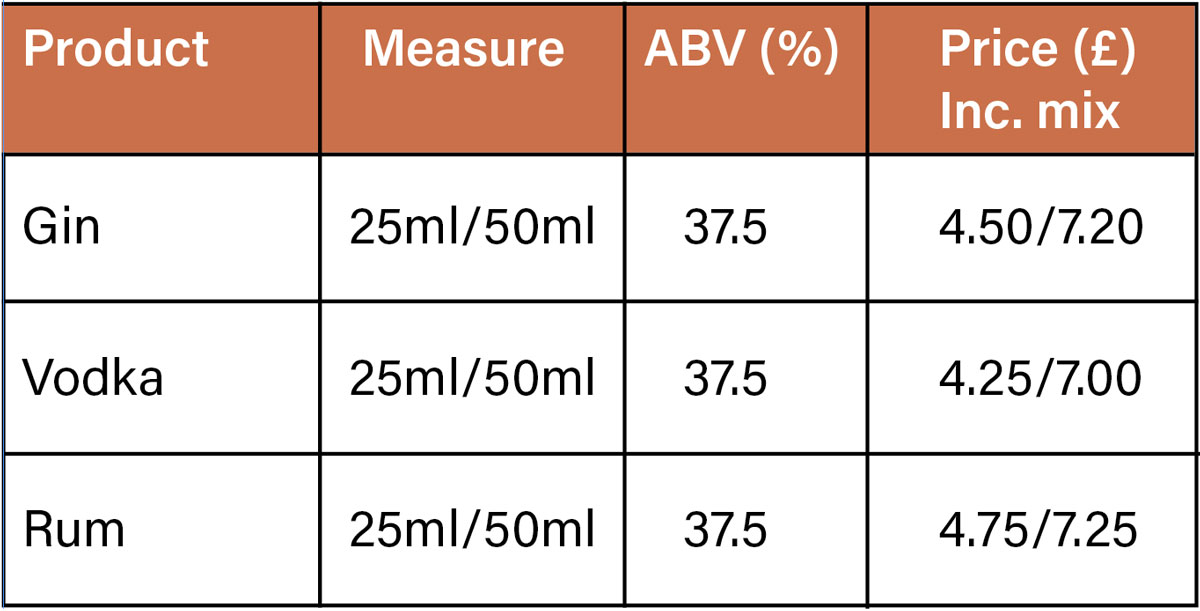
It has been put to me that it could be caught by another of the irresponsible promotions, namely prohibiting a promotion that “encourages, or seeks to encourage, a person to buy or consume a larger measure of alcohol than the person had otherwise intended to buy or consume”.
The key thing here is there is no inducement or promotional ‘double up for a…’
It simply states the price for a 25ml measure with mixer and the price of a 50ml measure with a mixer. Like the example of a pint, I am not getting my 50ml G&T in two glasses or contingent on the purchase of the first 25mls. The 50ml measure with mixer is simply available should I wish it.
There is in my mind an important distinction between a price list and an advertisement ‘pushing’ the double. For the avoidance of doubt the rules do obviously prohibit BOGOFs and the former ‘buy two large glasses get the rest of the bottle free’.
Alcohol as a prize or reward
Despite how seemingly clear the law is it continues to catch people out. The law states that alcohol cannot be used as a reward or prize unless the alcohol is in a sealed container and consumed off the premises. You can therefore win a bottle of wine in the pub quiz but only if it remains corked and is taken away. I do roll my eyes when the pub proudly advertises a prize like – ‘a pint for each member of the winning team’.
Conversely, I’ve equally rolled my eyes when it was suggested a pub quiz couldn’t offer a £50 voucher on the basis the winning team may use it to buy alcohol. They may but, as a matter of fact, alcohol is not the prize. A £50 cash equivalent voucher can be spent on tea/coffee, food, snacks and soft and/or alcoholic drinks. The voucher is the prize.
The 72 hour rule
Any variation to the price of alcohol must be in place at the commencement of licensed hours and remain constant for a minimum period of 72 hours. It must end at the termination of licensed hours. This pricing restriction rule put an end to ‘happy hour’ in pubs.
There is a subtle but important difference to the operation of the 72 hour rule between on and off-sales.
• Off-sales: each individual alcoholic product has its own 72 hour period independently;
• On-sales: the variation of any alcoholic product’s price sees all products fixed for the 72 hour period.

The 72 hour rule has been clarified when it comes to price variations between different customers. The Court decision clarifying this (Mitchells & Butlers Retail Ltd v Dundee City Licensing Board) centred on a student discount card in use at the Nether Inn in Dundee.
By sheer coincidence, I had circa five happy years working behind the bar in that very pub in my days as a law student!
The Court held that selling a pint to a card holder for £Y whilst simultaneously selling the same pint to a non-card holder for £X was not a price variation. The Court accepted that the different prices were legal because each class of person (card holder and non-card holder’s) prices do not change within the 72 hour period.
Unlimited drinks packages
Alas the fixed price Bottomless Brunch is a breach of the law if it involves the supply of unlimited amounts of alcohol for a fixed charge. These brunches often run truly unlimited south of the Border. Here in Scotland, done properly, the terms and conditions make the drinks limit clear.
Food can be all you can eat but the maximum number of drinks is limited and it should in my view include non-alcoholic alternatives.
Finally, the pricing and promotional material should not breach any of the other points discussed here.
Like any area of the law, two people reviewing the same thing may come to different views and disagreements regularly arise as to where the boundaries lie.
As underlined in this article, the devil is in the detail! I anticipate the Hassard Licensing hotline will continue to do a strong trade in pricing and promotions queries in the weeks and months ahead.

The advice offered in SLTN is published for information only. No responsibility for loss occasioned by persons acting or refraining from action as a result of material contained on this page or elsewhere in SLTN can be accepted by the author or publisher