By Niall Hassard
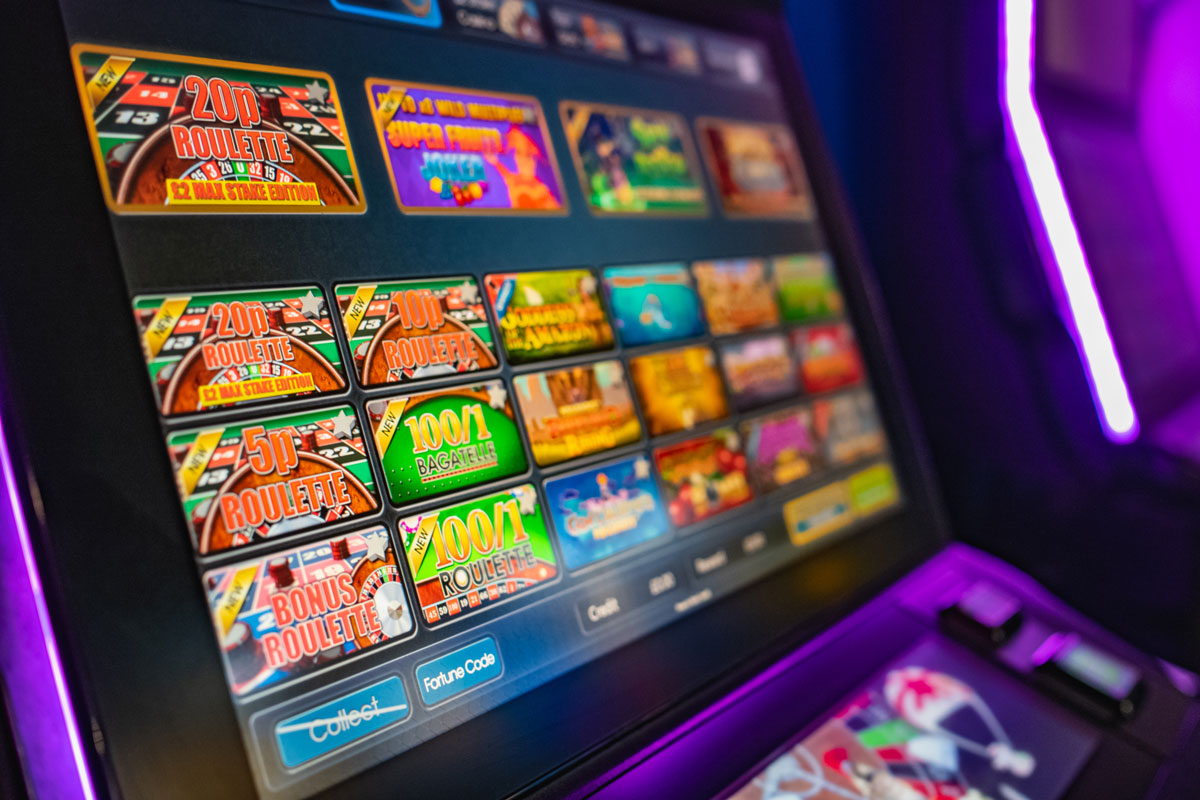
The quintessential pub to many is a dark wooden bar, some good hand pulled ales, a roaring open fire and, in the corner beside the bar, a puggie!
This is something the public and (dare I say it) the trade can often take for granted.
However, it is important for operators of pubs to know what the rules are for gaming machines and abide by them.
This guide will ensure that, if you are inspected by the local authority, you won’t be left spinning or find that your gaming machines leave you reeling.
Criteria to have a gaming machine
1. A premises licence holder can seek permission to provide gaming machines provided there is a bar over which alcohol is sold in the premises
2. The operating plan which forms part of the premises licence must elect “YES” at the relevant part of the Q5 matrix of activities which covers “gaming”
3. Gaming machines can only be played during licensed hours i.e. times when alcohol can be sold to customers
4. The licence holder must notify the local licensing board that they wish to have (up to two) gaming machines. Please note that when a premises licence transfers the entitlement to have gaming machines does not. Points 4 & 5 therefore must be undertaken by each new premises licence holder
5. Payment of £50 must accompany the notification to the local licensing board.
Rules and restrictions
Under the notification mentioned above (referred to as automatic entitlement) pubs are allowed up to 2 category C or D gaming machines.
The most popular machines tend to be category C.
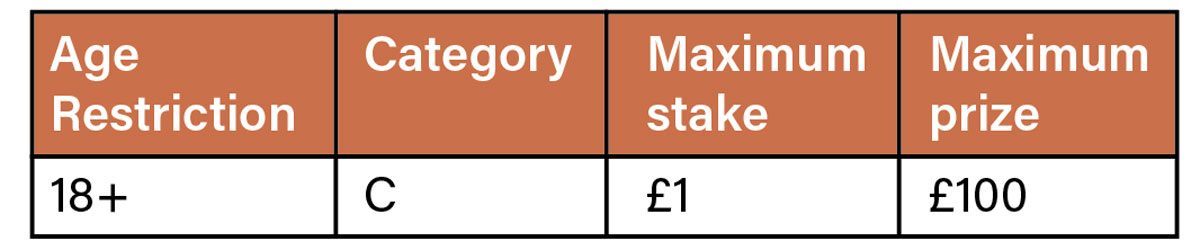
Category D machines cover a multitude of lower stakes and prizes machines including but not limited to the undernoted. These are rarely found in pubs in my experience.
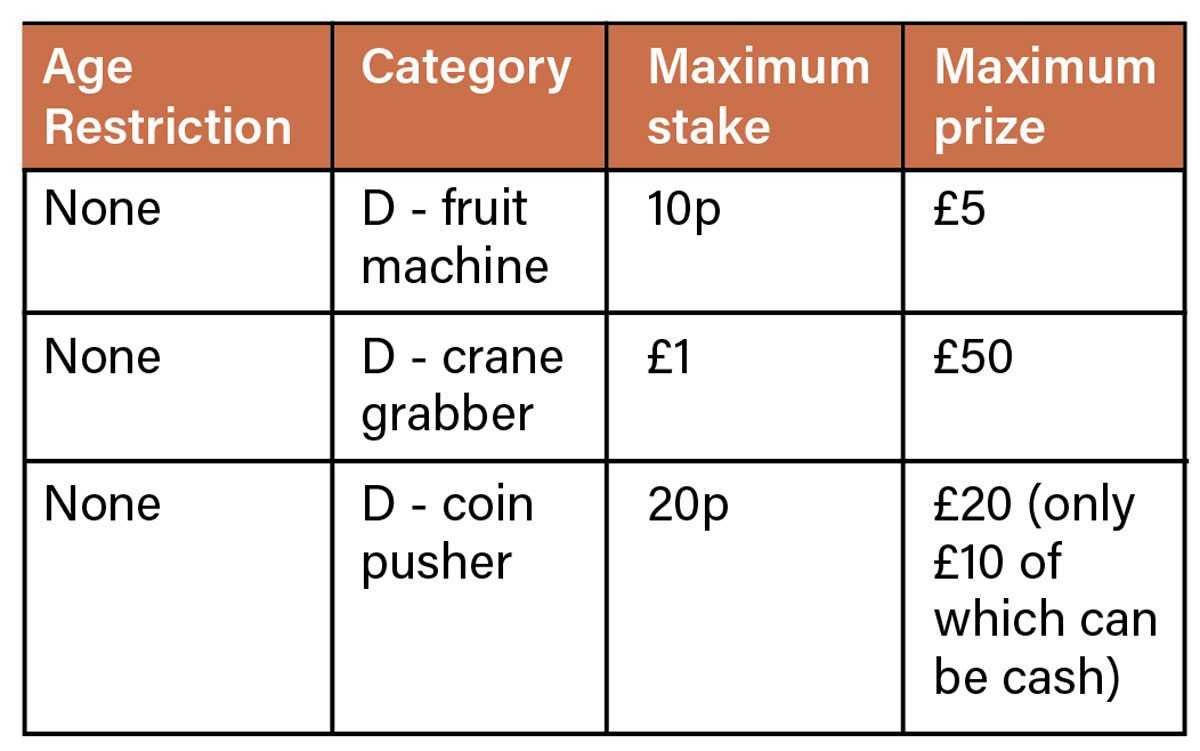
Location of machines
Any gaming machine must be in a location that allows it to be supervised by staff. It follows that staff training should include the rules and responsibilities around the use of any machine on the premises. A gaming machine must not be in a place with an ATM present. This means that any person wishing to use an ATM needs to cease gaming on the machine to go and get more cash.
Supervision of the machines is required for a couple of reasons including staff being able to spot any issues, for example, a customer remaining at the machine for an excessive amount of time or spending excessive amounts of money. The more obvious reason they need to be supervised is to ensure, in the case of category C machines, access is not afforded to under 18s.
Whilst CCTV is an option for supervising the machines, in practice, most premises will locate category C machines near the bar servery to allow them to be physically supervised by staff.
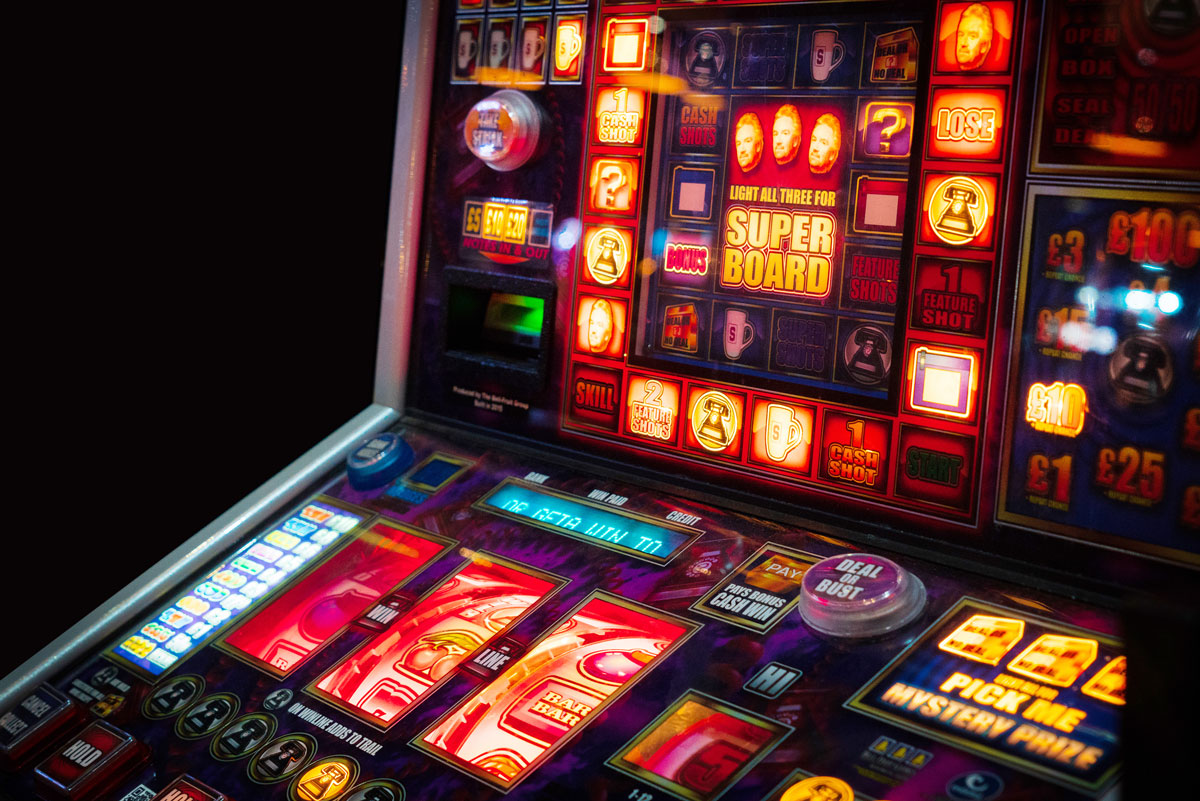
It is best practice to adopt a Challenge 25 policy in relation to category C machines and should a person you challenge not be able to produce ID proving they are over 18 access to the machine should be refused.
Technicalities
It is the licence holder’s responsibility to ensure that your machines meet the requirements set out in the regulations. Every machine must have a label prominently displayed stating:
• Machine category (C or D)


• Return to player percentage
• No under 18 sign (Category C only)
• ID plate (Machines manufactured after 2007)
• Stake to play and maximum pay-out prize
• Signposting for gambling support services (BeGamble Aware).
Whilst displaying supplier details is not a hard and fast requirement they are usually displayed. Having easy access to the supplier information can also assist staff should there be any issue or malfunction. Again, licence holders should, as a matter of best practice, have a policy on resolving any disputes.
If, for example, a machine fault means a player’s winnings are not dispensed a method of logging the issue, reporting it to the supplier and once resolved ensuring the winnings are paid to the customer demonstrates responsible machine management.
Failure to comply
Over the years the Gambling Commission and local authorities have staged undercover operations to audit compliance with the rules and in particular age restriction rules. If a premises is found to be in breach of the rules the automatic entitlement to have up to two gaming machines can be revoked. In extreme cases there is the risk of prosecution.
Other types of machines
Skill-based machines, such as quiz machines, are often popular additions to the pub environment. Whilst these quiz games often dispense cash prizes they are not gaming machines. The quiz games are wholly based on skill/knowledge and thus fall outwith the rules and restrictions on gaming machines.
As you can see the stakes are high if you get things wrong when it comes to managing gaming machines in your pub. Follow these tips to hit the jackpot when it comes to compliance!

The advice offered in SLTN is published for information only. No responsibility for loss occasioned by persons acting or refraining from action as a result of material contained on this page or elsewhere in SLTN can be accepted by the author or publisher.